
Enterprise Resident Lookup Coverage
A careful Enterprise resident lookup combines sources rather than treating one index as a master list. The Assessor and OpenWeb identify parcels and owners of record. The Recorder associates principal parties with recorded documents. Courts can reveal public case information in the correct jurisdiction. Election, vital, custody, and license systems have narrower purposes and limits. The right source depends on whether the question is about a parcel, a recorded document, a public case, a historical event, or an authorized status check.
| Record | What It Confirms | Where | Access |
|---|---|---|---|
| Assessor parcel card | Owner of record, parcel, situs and mailing fields | Clark County Assessor and OpenWeb | Public search; owner is not automatically occupant |
| Recorder index and copy | Principal party, instrument, date and parcel link | Clark County Recorder | Online index has record-specific limits; older material may require microfilm |
| Public court case | Party role, case number, case type and dates where public | Clark County Courts or the correct local court | Jurisdiction and sealing restrictions apply |
| Vital record route | Historical event lead or eligible certificate request | Nevada Office of Vital Records and county routing | Eligibility and historical thresholds apply |
| Voter and license systems | Authorized status or public association fields | Clark County Elections and issuing agencies | Protected fields and address meanings limit use |
Start with the source that has the best anchor. A street or parcel points to property records. A document number points to the Recorder. A case number, date, and court division point to court records. A dated obituary or directory item is historical corroboration, not present-address proof.
Enterprise Resident Lookup Needs Two Anchors
Use two independent anchors before connecting a name to an Enterprise record. A useful pair might be a full name and an exact street, an APN and recorded date, a middle initial and court number, or a historical publication and year. Enterprise is an unincorporated Clark County town, and an Assessor or OpenWeb card can show legal town as Enterprise while a mailing line reads Las Vegas. That legal-town versus postal-city difference is a reason to save the source fields instead of normalizing them into one label.
Same-name controls are essential. Compare initials, suffixes, company or vesting names, situs address, document date, and legal description. If those details do not converge, leave the lead unverified. An owner, a recorded party, a mailing contact, and a telephone subscriber are different roles. Recording the source URL, search date, and exact search terms makes a later correction possible when a portal changes its layout or its data updates.
Enterprise Owner and Recorder Search
The Clark County Assessor Real Property Records owner form requires a last name or company and accepts an optional first name and phonetic option. It lets the user select the current parcel-number record or present and prior owners. That selection can show a parcel relationship, but it cannot by itself prove that an owner lived at the situs address. Preserve whether the current or present-and-prior option was used.
The Clark County Recorder name index has last name, first name, company name, Starts With, Contains, and Exact match modes, plus book type, from and to dates, document type, and show-names controls. Search spelling variants separately. Match mode and date range are part of the evidence. A company filing or return address should not be called a personal residence without a separate source that supports that statement. A license address can likewise be an office, mailing, or registered-agent field rather than personal residence evidence.
Note: Assessor and Recorder records can confirm different facts about the same parcel, so retain both the record date and the role shown by each office.
Enterprise Court Lookup by Jurisdiction
Clark County Courts Odyssey public case inquiry offers routes for Family Records, District Civil and Criminal Records, and Court Calendar inquiry, with separate choices for family, district civil or criminal, and Las Vegas Justice Court civil and traffic matters. Court guidance says online records generally cover 1990 to the present, although division and case-type availability vary. Older research can continue through the clerk or microfilm route. Sealed matters, family minutes, and some trial records are not online.
Las Vegas Municipal Court is separate and has City of Las Vegas jurisdiction. Its public lookup requires last name and date of birth, while first name is optional. An Enterprise mailing address does not make every matter a Municipal Court case. Select the court from the incident and case jurisdiction, then inspect the party role and filing date rather than assuming a party is an Enterprise resident. The Municipal Court records-research form supplies a separate request route for a full or specific case record.
Open the Las Vegas Municipal Court lookup only when its jurisdiction fits the known case.
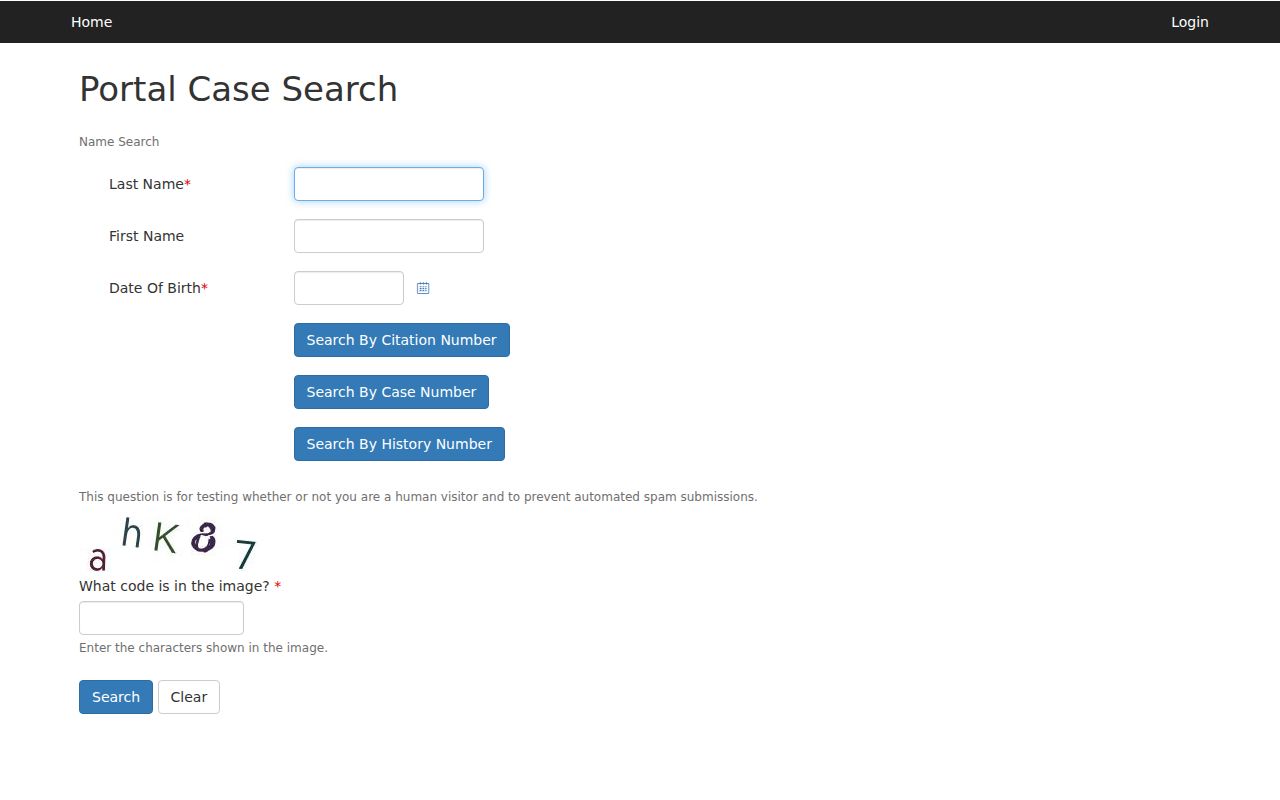
The form illustrates its last-name and date-of-birth gate, not a Countywide or Enterprise-specific resident index.
Enterprise Court Result Fields
A public case result is an index lead. The captured Clark County public case-list schema shows a case number, case style, and plaintiff or defendant party roles. It does not establish an address, a complete case history, or a result beyond the fields made public. Keep the case number and role with the court and date, then use the clerk’s stated request route if a public copy is needed for a lawful purpose.
| Case number | The court’s identifier for the specific public matter. |
|---|---|
| Case style | The caption as displayed, which names the parties or case title. |
| Party roles | Roles such as plaintiff and defendant shown in the public list. |
| Jurisdiction | The court or division that controls whether the matter belongs in that search. |
Do not fill in a complete docket, disposition, address, or protected identifier from this sample. The live portal and the clerk's filing and copy-request guidance remain the source for any authorized record request.
Verifying an Enterprise Resident Lookup
Verification is a short, repeatable comparison, not a broad name search. Begin with the strongest public anchor and move only to sources that answer the next question. For a current parcel lead, legal town and APN are more reliable identifiers than a mailing-city label. For a court lead, the case number, jurisdiction, and party role matter more than the name alone. Historical directories and newspapers can corroborate a date, but they should remain dated evidence.
- Record the full name, spelling variants, and one independent anchor such as a situs address, APN, document date, or case number.
- Check the Assessor’s current or present-and-prior owner view and save the legal town, APN, and role shown.
- Run the Recorder search with the documented match mode and date range, then compare the indexed party and parcel details.
- Use the correct court division only when a case number, jurisdiction, or party-role clue supports it.
- Label any unmatched result unverified and preserve a source date instead of treating a no-result as proof.
- Docket
- A court’s running case record; a short public list is not necessarily the complete docket.
- Index
- A searchable list of record references or summaries that points to a document or case.
- Image
- A scan or copy of the underlying record, which can have different access rules from the index.
- Certified copy
- A copy issued and certified by the responsible custodian for purposes that require official authentication.
Enterprise Vital and Voter Limits
Nevada vital-records forms and routing are for eligible requests, not a current Enterprise name index. Under NRS Chapter 440, birth certificates become public 125 years after birth and death certificates 50 years after death. Current birth, death, marriage, divorce, amendment, paternity, and court-ordered records have event-specific access or eligibility limits. A historic notice can be a dated family lead but is not proof of a current address.
Clark County Registered Voter Services has a protected login or lookup flow whose stable public fields were not captured. Nevada NRS Chapter 293 protects sensitive registration fields and can protect registration location or address information. Election reports and authorized data routes are not a reason to republish person-level voter details. Use the individual status route for its stated purpose and rely on the current official interface for any live fields.
Review the Nevada Vital Records forms before requesting an eligible certificate or verification.
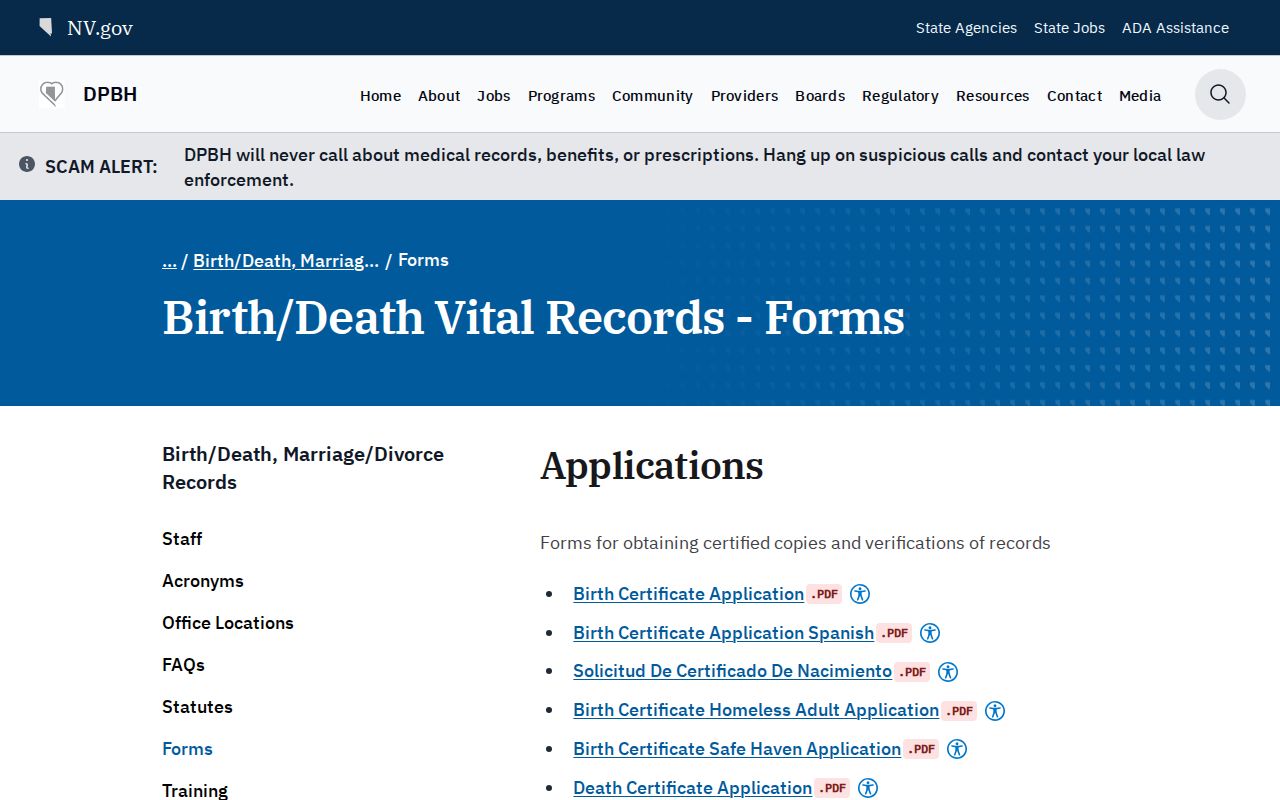
The forms route helps match an event and applicant eligibility to the custodian, while avoiding any suggestion that current vital records are a public lookup list.
Enterprise Custody Lookup Scope
The Clark County Detention Center directs users to an in-custody search by last name, inmate ID, or Justice Court case number. It is a current-custody tool, not an address source. People under 18 and protective-custody records do not display, and custody status can change quickly. A no-result does not prove that a person was never detained or that no record exists elsewhere.
CCDC is not a universal list of local, state, federal, or historical custody records. Booking location and court venue matter more than a mailing address. Nevada’s public registry conditions and search route are separate, with statutory publication and use limits. Do not connect a CCDC search result to an Enterprise street, and do not infer conduct from a booking or search result. The appropriate next step for a public case is the court with jurisdiction.
Use the CCDC in-custody search only for its stated current-custody scope.
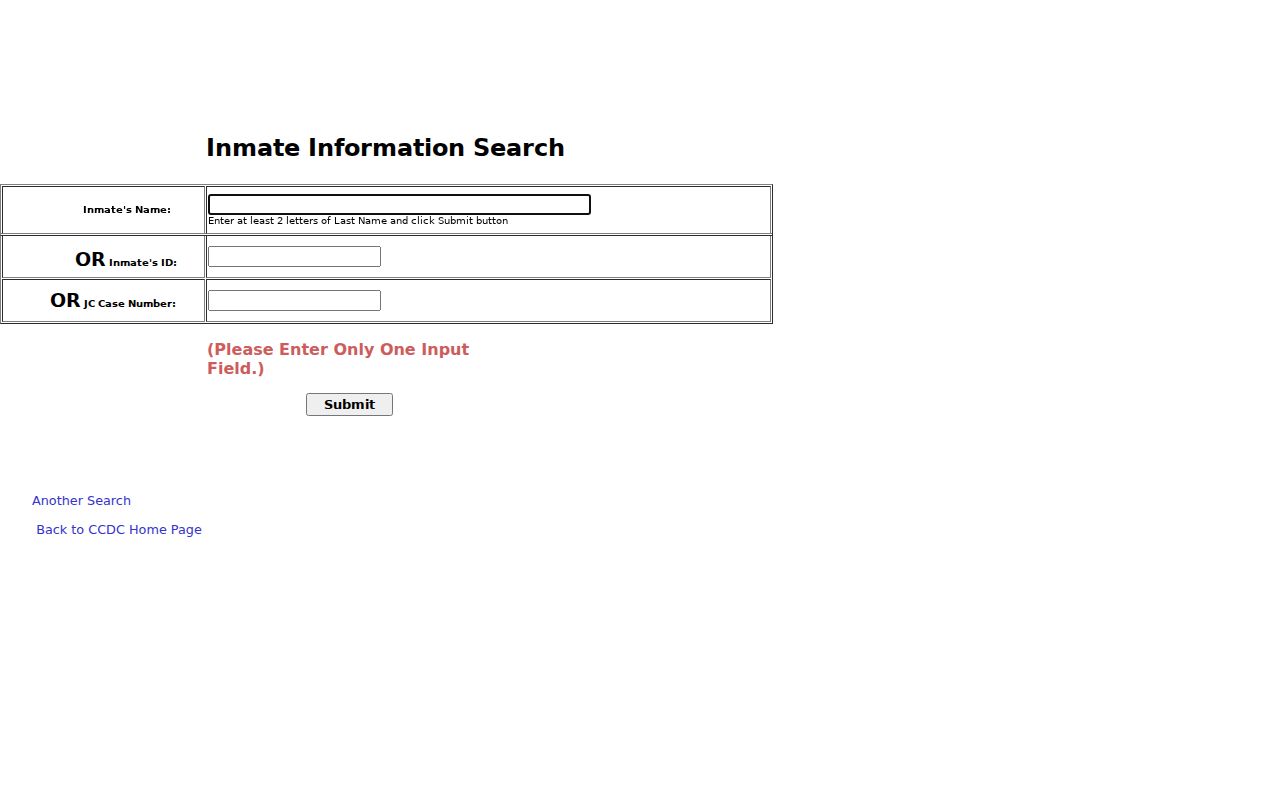
The search controls show the limited routes available for a current custody check and do not establish residence or a complete history.
Enterprise Resident Lookup Legal Limits
Nevada public-record access has boundaries. Nevada’s Confidential Address Program shields eligible victims of domestic violence, sexual assault, human trafficking, and stalking through a fictitious-address and mail-forwarding process. Recorder protections under NRS Chapter 247 and voter protections under NRS Chapter 293 can restrict address information. Nevada DMV records are not open through an ordinary request for name, address, or date-of-birth information. A visible field is not an invitation to copy it into a profile.
Lawful use. Use Enterprise resident lookup results for personal, lawful research, verify them with the custodian, and never use a record to stalk, harass, intimidate, or expose a protected address.
For a correction or protected-address concern, use the issuing custodian’s process and retain the source URL and date. The Nevada Confidential Address Program is the official protected-address route for eligible participants.
Enterprise Public Records Follow-Up
When an online search ends, a focused request to the right custodian is more useful than a sweeping request about a person. Under the Nevada Public Records Act, NRS Chapter 239, a custodian generally has five business days to make a record available, provide a written denial with legal authority, or give written notice that the record is not yet available and state when it will be available. Actual costs or another stated fee schedule may apply.
Name the department, record type, date range, names, APNs, case numbers, and preferred delivery. Ask whether a redacted version is available or another office holds the record. Clark County’s public-record request hub and the responsible court, Recorder, Assessor, Elections, or issuing board each have different custody. Portal fields and record availability change, so mark the request and every search result with its source date.